|
| |
| News
updates: |
| |
|
|
|
|
|
|
| |
| |
| |
|
| Forthcoming Events
|
| |
| 01-02 November 2025 |
: |
International Conference
Notice
|
| 30-31 August 2025 |
: |
International Conference
Notice
|
| 19 April 2025 |
: |
Seventy Five Years of the Constitution of India Organized by RGNUL, Punjab in
association with AILTC
|
| 26 April 2025 |
: |
Seventy Five Years of the Supreme Court of India Organized by RGNUL, Punjab in
association with AILTC
|
| 27 April 2025 |
: |
National Conference on Direct Tax Laws Organized by RGNUL, Punjab In
association with AILTC
|
| 18-19 January 2025 |
: |
Two-day National Conference on "Transforming Legal Landscape and Reforms Reforms
Invitation and Registration Form
|
| |
|
|
| |
|
|
|
|
|
| |
| All India Law Teachers
Congress |
|
The All
India Law Teachers Congress (AILTC) strives
to protect and promote the rights and interests of law
teachers across India. As you all know, the All
India Law Teachers Congress (AILTC) is about
14 years of age, and its membership is growing over
the years. We are very happy and satisfied about this
swelling membership of the Congress, thanks to the overwhelming
support of the members of AILTC.
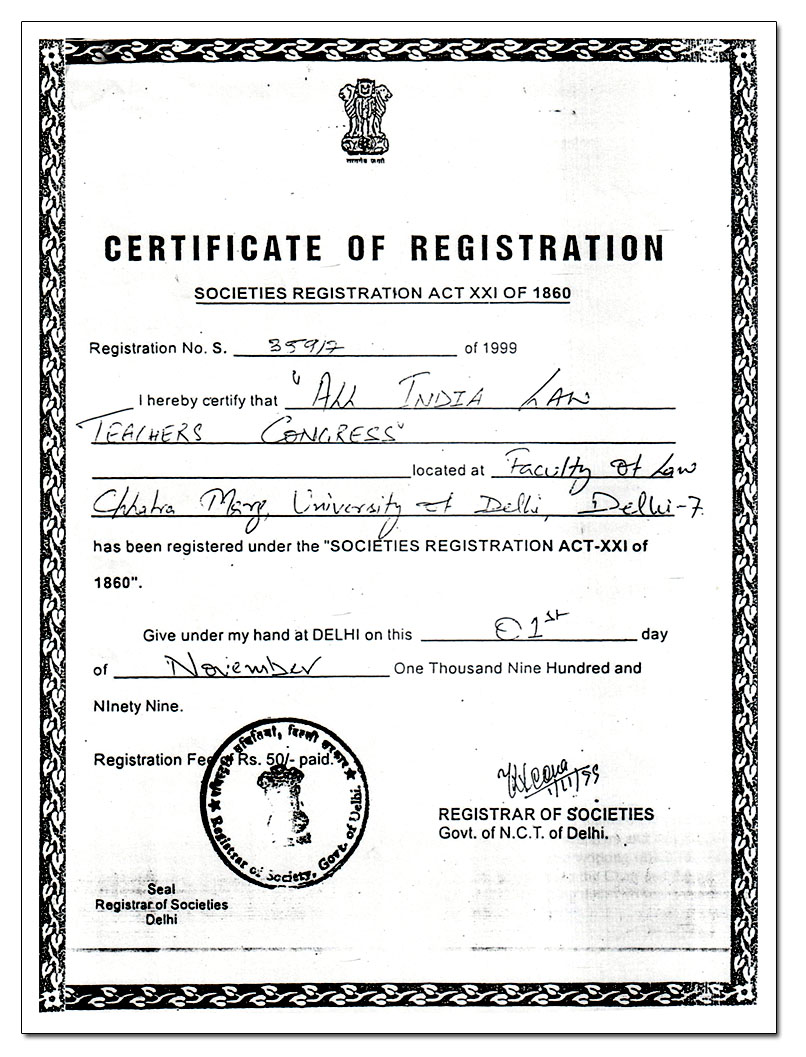
All India Law Teachers Congress (AILTC)
is a registered Society. The members of the AILTC
are teachers of law, teaching in various universities
and colleges in India. It has about 600 members. The
aims and objectives of the AILTC are
to promote the interests of legal education and members
of law teachers. It organizes conferences, seminars
and discussions on legal education. The AILTC
also strives to protect and promote the rights and interests
of law teachers across India. It coordinates with Bar
Council of India (BCI), University Grants Commission
of India (UGC) and other similar bodies for wider dissemination
of legal education. |
|
| 1st CILRAP Scholarship
for International Law (India) |
Any Indian citizen
residing in India can compete for this 1st CILRAP Scholarship
for International Law (India). There are no age or occupational
limitations to participation. The topic is ‘What
can India and Indian actors do to strengthen the system
of collective security based on the United Nations Charter,
including by deterring the illegal use of armed force
in violation of the Charter?’. The winner will
be awarded a Scholarship of USD 10,000; number two,
USD 2,000, and number three, USD 1,000. Papers must
be submitted to scholarship@cilrap.org by 15 October
2016 in the English language and contain between 9,000
and 10,000 words (or between 60,000 and 70,000 keystrokes,
footnotes, empty spaces and a short author-biography
included). CILRAP is offering this Scholarship together
with the Indian Society of International Law, Jindal
Global University Law School, and Delhi University Campus
Law Centre. The Scholarship is facilitated by a financial
contribution to CILRAP by the Nuremberg prosecutor Benjamin
B. Ferencz, Professor Donald M. Ferencz, and their Planethood
Foundation. CILRAP reserves the right to publish the
winning papers. Queries may be addressed to scholarship@cilrap.org.
https://www.cilrap.org/cilrap-scholarships/ |
|
| New Book Release |
MODERN
GATT LAW (TWO VOLUME 2ND EDITION
(By
Professor Raj Bhala)
Associate Dean for International and Comparative Law
and Rice Distinguished Professor
The University of Kansas
School of Law, USA
 View/ Download
Modern
GATT Law (Two Volume 2nd Edition) Flyer
Modern
GATT Law (Two Volume 2nd Edition) Post Card
Dictionary
of International Trade Law (2nd Edition, LexisNexis,
Bhala) |
|
HUMAN RIGHTS
AND ANTI-TERRORISM LAWS IN INDIA
(Author: Dr. Kavita Singh)
It is an effort to address the recent developments in
this area. Author has discussed in detail the anti-
terror statutes, Supreme Court and High Court cases.
The book is basically for the judges, police, public
prosecutors, academicians and the students of criminal
law, criminology & victimology, political science,
international law etc.
CENTRAL LAW
PUBLICATIONS PVT. LTD.
107, Darbhanga Castel, Allahabad,
Phone: (0532) 2461178, 2461123
Fax: (0532) 2461123
E-mail: clp.editorial@gmail.com |
|
HUMAN RIGHTS
AND JUSTICE: International Documents
Wg
Cdr (Retd) Dr U. C. Jha(2010)
Access to Justice is basic human rights as well an indispensable
means of combating poverty and preventing and resolving
conflict. This book contains over 62 international documents
dealing with human rights and justice under one cover.
This handy reference is a must for legal fraternity,
NGOs, human rights activists, academicians and researchers.
Publisher: (Vij Books India Pvt. Ltd., Darya Ganj, New
Delhi 110002)
Author can be contacted on ucjha1@rediffmail.com |
| |
|

 .
.